In many factories and warehouses, packaging machines are installed, but the line still moves slowly.
The carton sealer is working, but workers manually bring cartons to the machine.
The strapping machine is available, but cartons wait in piles before reaching it.
The stretch wrapping machine is ready, but pallets are moved slowly by hand.
The packing team is active, but product movement between stages is unplanned.
Dispatch is delayed because goods are not flowing smoothly from packing to storage.
This problem is not always because of the packaging machine. Many times, the real bottleneck is material movement.
This is where conveyor systems become important.
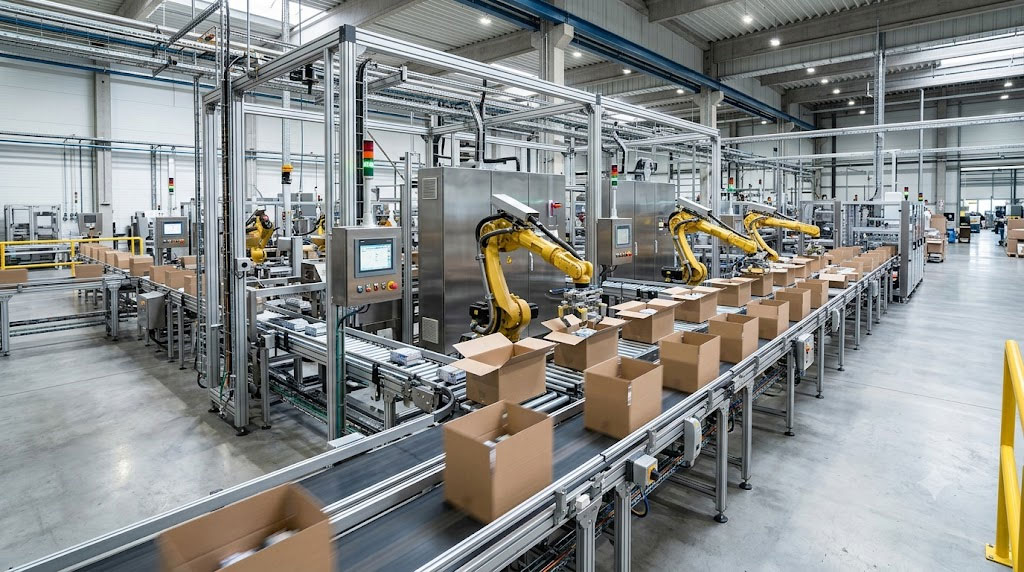
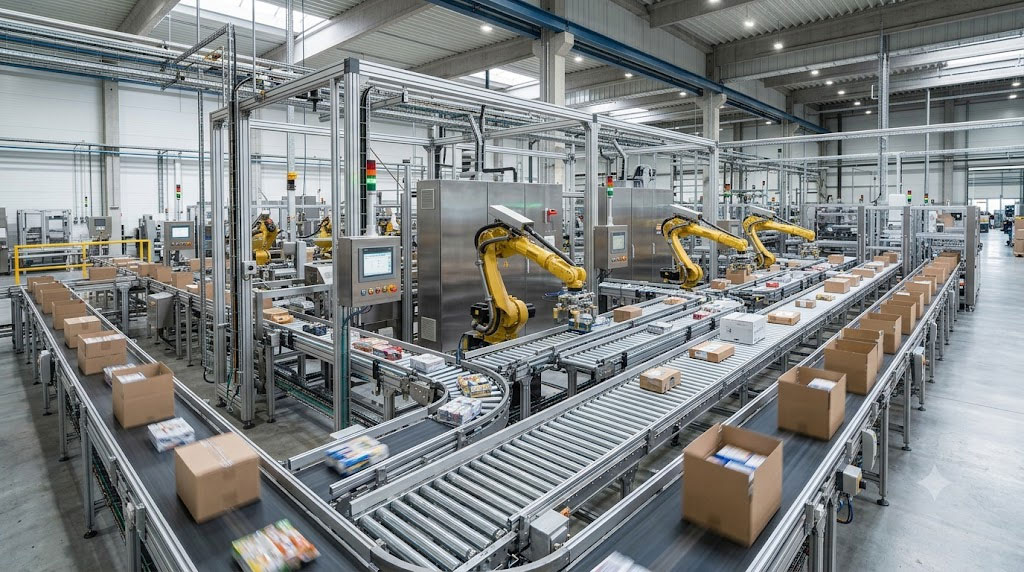
Conveyor systems help move cartons, boxes, bags, packets, pallets or products from one stage to another in a controlled and continuous way. In packaging lines, conveyors connect packing tables, carton sealers, strapping machines, coding machines, inspection stations, shrink packing areas, palletising points and dispatch zones.
For factories, warehouses, FMCG units, e-commerce hubs, pharma dispatch centres, engineering goods manufacturers and export packaging units, the right conveyor system can reduce manual handling, improve speed and create a smoother packaging workflow.
Sharp Engineering offers conveyor systems, packaging machines and material handling equipment for local Mumbai, Pan India and export buyers looking to improve packaging, movement and dispatch efficiency.
Why Packaging Lines Become Slow Without Conveyors
Many companies invest in packaging machines but continue to move goods manually between machines.
This creates waiting time.
A worker brings a carton to the sealing machine. After sealing, another worker carries it to the strapping area. After strapping, the carton is moved again for stacking. Then pallets are manually shifted for wrapping. Every stage depends on labour availability and physical movement.
Even if each machine is working properly, the overall line becomes slow because goods are not moving continuously.
Without conveyors, factories face common problems:
Cartons wait between machines.
Workers spend time lifting instead of packing.
Manual movement causes fatigue.
Heavy cartons create safety risks.
Product flow becomes irregular.
Dispatch speed depends on labour strength.
Packaging areas become crowded.
Output becomes difficult to control.
Conveyors solve these problems by keeping products moving in an organised direction.
What Is a Conveyor System?
A conveyor system is a mechanical handling system used to move goods from one point to another.
In a packaging or warehouse setup, conveyors may move cartons, boxes, bags, packets, containers, trays or products between different process stages.
For example:
From packing table to carton sealer
From carton sealer to strapping machine
From strapping machine to inspection area
From production area to packaging area
From packaging line to dispatch area
From warehouse storage to loading zone
From coding station to collection table
From shrink packing line to carton packing section
The main purpose of a conveyor system is to reduce manual movement and improve process flow.
Role of Conveyors in Packaging Automation
Packaging automation is not complete if products still need to be carried manually between machines.
Conveyors act as the connecting system between packaging equipment.
A carton sealer improves box closing.
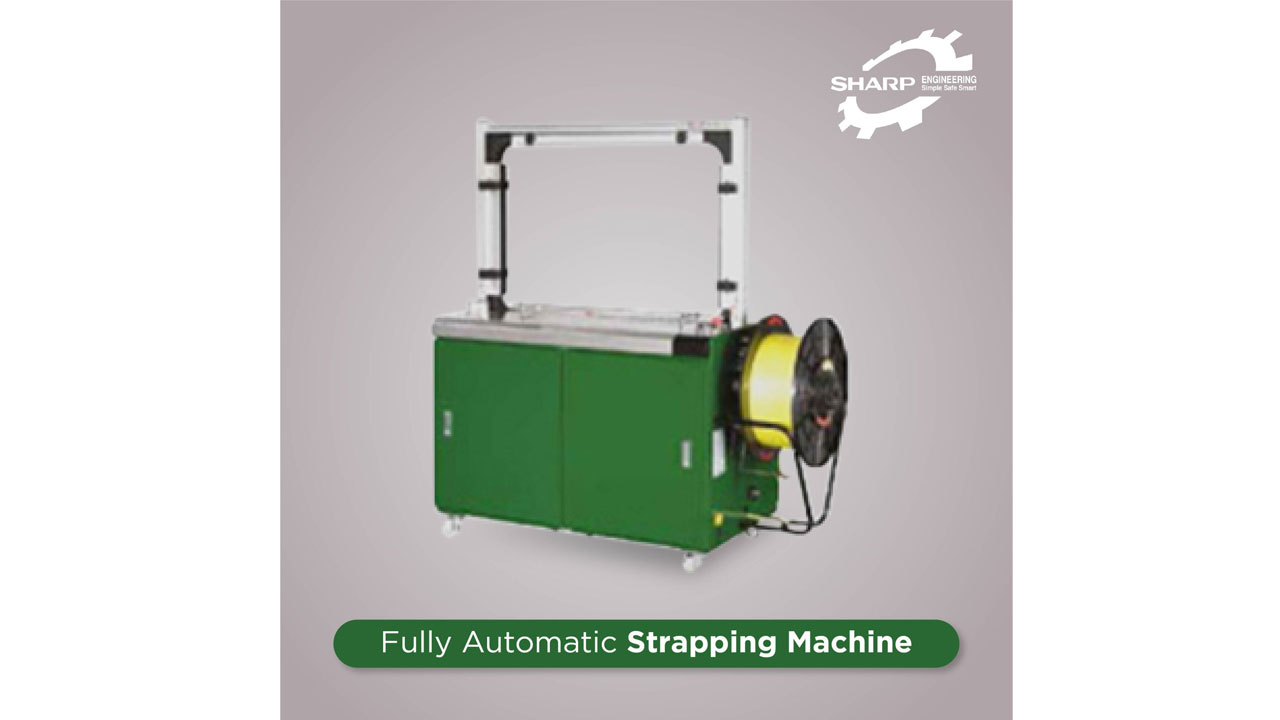
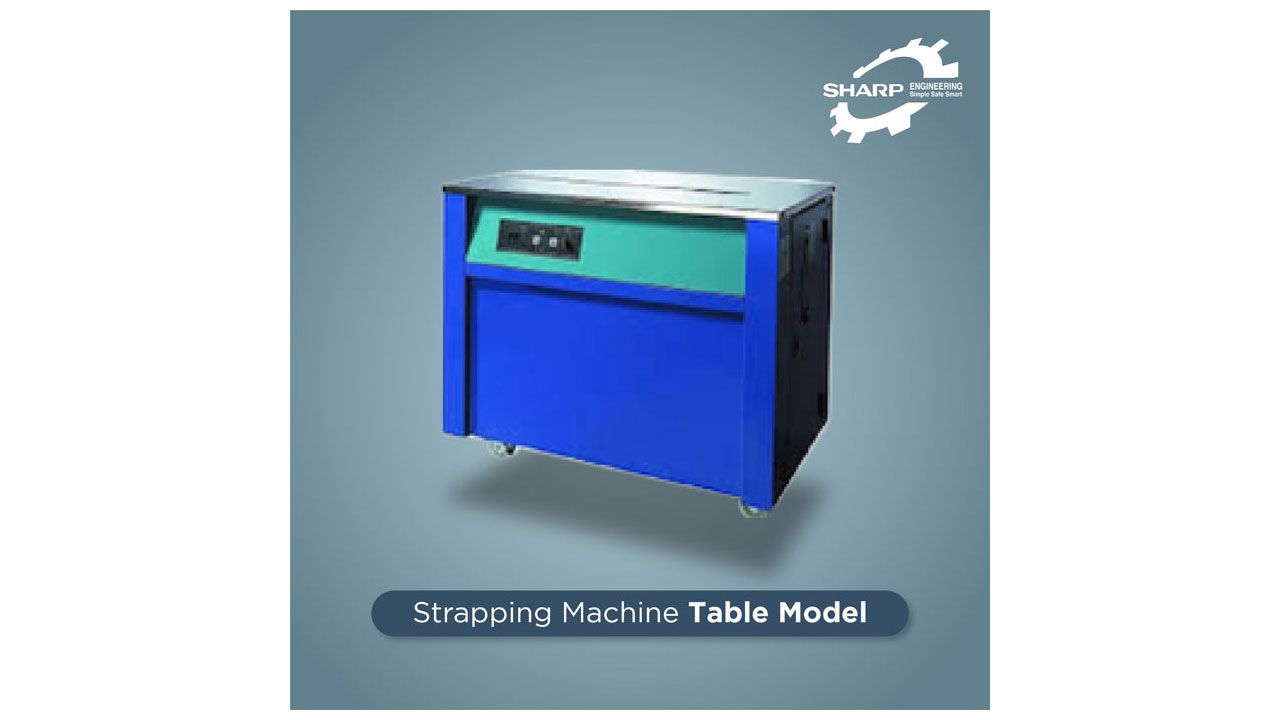
A strapping machine secures cartons.
A shrink packing machine protects and presents products.
A stretch wrapping machine stabilises pallet loads.
But conveyors help connect these processes into one line.
This is why conveyors are important for end-of-line packaging, secondary packaging, warehouse dispatch and production movement.
A good conveyor system improves the efficiency of all machines around it.
Main Types of Conveyors Used in Packaging Lines
Different products require different conveyor types. The right selection depends on product weight, size, shape, base condition, speed requirement and factory layout.
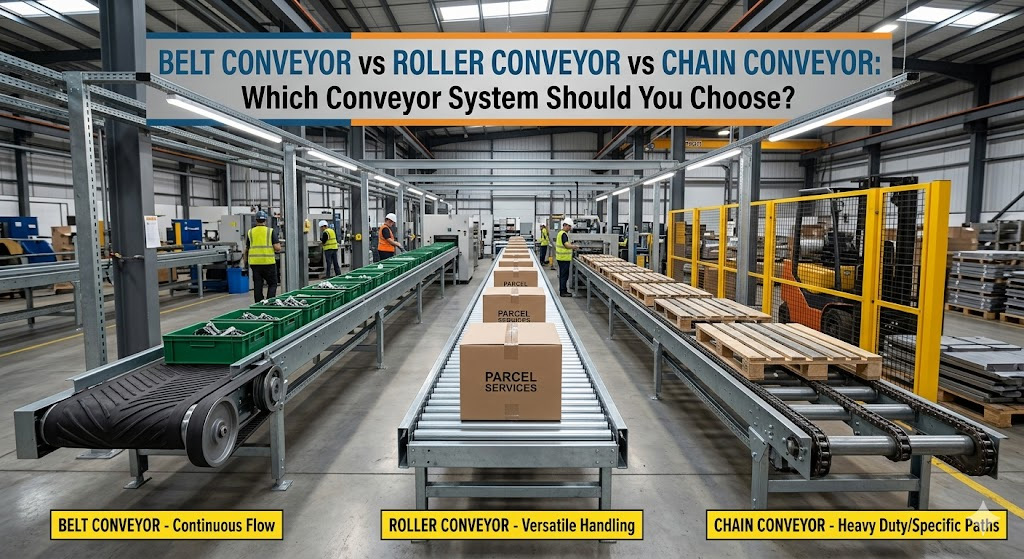
Belt Conveyor
A belt conveyor uses a continuous belt to move products from one point to another.
It is suitable for cartons, packets, bags, pouches, boxes, loose items and lightweight to medium-weight products.
Belt conveyors are commonly used in:
Packaging lines
Food processing units
FMCG plants
Pharmaceutical dispatch
E-commerce warehouses
Inspection lines
Sorting areas
Assembly lines
Bag movement
Carton movement
A belt conveyor is useful when products need stable movement and cannot move smoothly on rollers.
For example, bags, pouches and small packets are usually better suited for belt conveyors.
Roller Conveyor
A roller conveyor uses rollers to move cartons, boxes or products with a flat base.
It is commonly used in warehouses, packaging lines and dispatch areas.
Roller conveyors are suitable for:
Carton boxes
E-commerce parcels
Warehouse dispatch cartons
Industrial boxes
FMCG cartons
Pharma cartons
Logistics sorting
Packing line movement
Inspection and accumulation
Roller conveyors are very useful when cartons need to move between carton sealing, strapping, checking and dispatch stages.
They can reduce manual carrying and help operators push or move cartons with less effort.
Chain Conveyor
A chain conveyor is used for heavier or stronger material movement requirements.
It is suitable where products are heavy, industrial or require more robust movement support.
Chain conveyors are useful in:
Engineering goods movement
Heavy cartons
Industrial load transfer
Pallet movement applications
Manufacturing plants
Heavy packaging lines
Automotive component movement
Metal part handling
For products that are too heavy or unsuitable for normal belt or roller movement, chain conveyors can be a better choice.
Inclined Conveyor
An inclined conveyor is used when material needs to move from one height to another.
It is useful in factories where products need to move from lower-level production to higher-level packaging, or from one machine height to another.
Inclined conveyors are commonly used in:
Food processing
Packaging lines
Bag movement
Carton movement
Material transfer between heights
Loading support
Factory process movement
They reduce manual lifting and help connect different height levels in a practical way.
Truck Loader Conveyor
A truck loader conveyor helps move cartons, bags or packages into trucks or containers.
This is useful for warehouses, logistics hubs, FMCG dispatch, export packing units and high-volume loading areas.
Manual loading can be slow and labour-intensive. A truck loader conveyor can improve loading speed and reduce worker fatigue.
This is especially useful for businesses with frequent dispatch, bulk loading or export shipments.
How Conveyors Improve Packaging Line Efficiency
They Reduce Manual Handling
Manual movement is one of the biggest hidden costs in packaging.
Workers lift cartons, shift boxes, push loads and carry products between stages. This slows the line and increases fatigue.
Conveyors reduce this manual movement.
Instead of workers carrying every carton, the conveyor moves products continuously.
This allows workers to focus on machine operation, inspection, quality checking and dispatch coordination.
They Improve Packaging Speed
A packaging line becomes faster when products move without unnecessary waiting.
If a carton reaches the sealing machine continuously, the carton sealer can perform better.
If sealed cartons move directly to the strapping station, the strapping process becomes smoother.
If cartons move toward palletising or dispatch without manual delay, total output improves.
Conveyors help maintain line rhythm.
They Reduce Labour Dependency
Many factories depend on workers for movement instead of productive work.
When conveyors are installed, fewer people are needed for repetitive carrying and shifting.
This does not mean labour is removed completely. It means the same team can handle more output with less physical strain.
For Indian factories and warehouses facing labour shortage or high labour cost, conveyors can deliver practical productivity improvement.
They Improve Safety
Manual lifting can cause injuries, fatigue and product handling mistakes.
Heavy cartons, repetitive lifting and awkward movement create safety risks.
Conveyors reduce repeated manual lifting and help create a safer working environment.
This is important for factories handling high carton volumes, heavy products or long working hours.
They Reduce Product Damage
Products can get damaged when workers drop cartons, drag boxes or stack goods incorrectly.
Conveyors provide controlled movement and reduce rough handling.
For fragile goods, pharma cartons, electronics, FMCG products, retail packs and export goods, controlled movement can help reduce damage risk.
They Improve Space Organisation
A packaging area without conveyors often becomes crowded.
Cartons are kept near machines. Workers stand in movement paths. Finished goods wait in piles. Dispatch sections become blocked.
A conveyor creates a defined path for movement.
This improves floor discipline and makes the packaging area cleaner and more organised.
They Help Connect Multiple Machines
One of the biggest advantages of conveyors is integration.
Conveyors can connect:
Packing tables
Carton sealers
Strapping machines
Shrink packing machines
L sealers
Coding stations
Inspection stations
Palletising areas
Stretch wrapping machines
Dispatch zones
This creates a proper end-of-line packaging flow.
Conveyor System for Carton Sealing Lines
A carton sealing line becomes much more efficient when cartons move smoothly before and after the carton sealer.
Without conveyors, workers manually place cartons into the machine and remove them after sealing.
With conveyors, cartons can be fed more consistently and collected more efficiently after sealing.
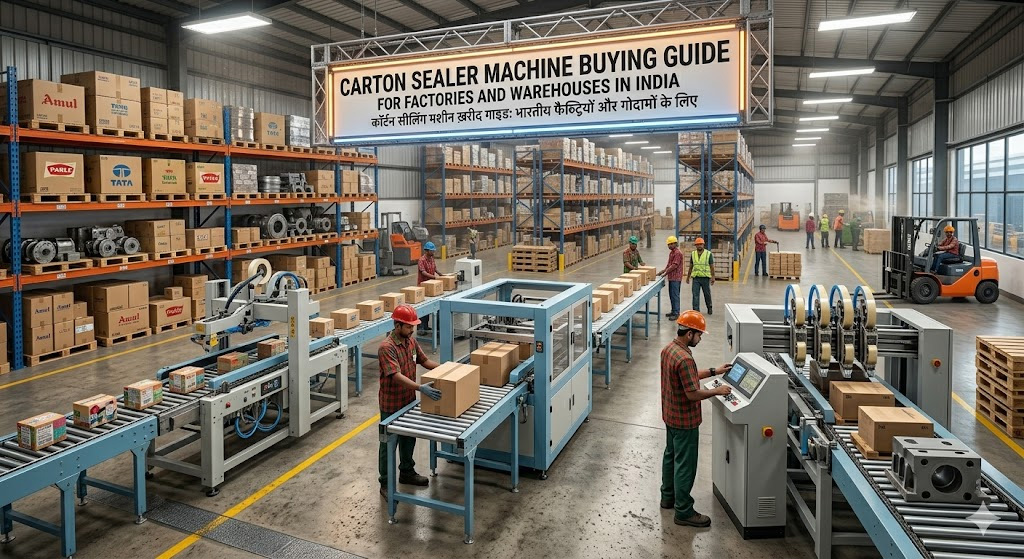
A practical carton sealing setup may include:
Packing table
Belt conveyor or roller conveyor
Carton sealer
Roller conveyor
Strapping machine
Dispatch conveyor
This improves speed and reduces manual movement.
Conveyor System for Strapping Lines
Strapping machines work better when cartons reach the machine in an organised way.
A conveyor can bring cartons from the sealing area to the strapping machine. After strapping, the cartons can move further toward sorting, palletising or dispatch.
For high-volume operations, a conveyor-supported strapping line improves speed and reduces operator fatigue.
A practical strapping line may include:
Carton sealer
Roller conveyor
Semi-auto or fully auto strapping machine
Exit conveyor
Palletising area
Conveyor System for Shrink Packing Lines
Shrink packing often requires product feeding, film sealing, heat shrinking and collection.
A conveyor system helps products move between these stages.
For FMCG, food, cosmetics, stationery, bottles and retail products, shrink packing lines benefit from smooth movement.
A practical shrink packing setup may include:
Product loading table
L sealer
Shrink packing machine
Cooling or collection conveyor
Carton packing area
This improves product finish and line productivity.
Conveyor System for Warehouse Dispatch
Warehouse dispatch requires movement from storage, packing, sorting and loading.
Conveyors can reduce manual carrying across long distances.
In e-commerce, logistics and distribution centres, conveyors help move parcels and cartons between different zones.
A warehouse conveyor setup may include:
Picking area
Packing table
Carton sealer
Sorting conveyor
Strapping area
Dispatch conveyor
Truck loader conveyor
This helps increase dispatch speed and reduce congestion.
Conveyor System for Export Packaging
Export packaging requires strong and organised movement because goods usually pass through multiple stages before shipment.
A conveyor can support carton sealing, strapping, checking, palletising and loading.
For exporters, conveyors can reduce product damage and improve packaging consistency before goods move to transport or container loading.
A practical export packaging setup may include:
Carton packing
Carton sealing
Strapping
Inspection
Palletising
Stretch wrapping
Truck loading
Conveyors can help connect these steps more efficiently.
Conveyor Selection Based on Product Type
For Cartons and Boxes
Roller conveyors and belt conveyors are commonly suitable.
If cartons have a flat and stable base, roller conveyors work well.
If carton movement needs more control or the product is lighter, belt conveyors may be used.
For Bags and Pouches
Belt conveyors are usually better because bags and pouches may not move smoothly on rollers.
Food products, agro products, chemicals, powders and granules often need belt conveyors.
For Heavy Industrial Goods
Chain conveyors or heavy-duty roller conveyors may be required.
The selection depends on weight, base structure and movement requirement.
For Small Packets
Belt conveyors are generally suitable because small products need continuous surface support.
For Pallet Movement
Chain conveyors or specialised roller systems may be needed depending on pallet size, load weight and movement direction.
Conveyor Selection Based on Industry
E-Commerce and Logistics
E-commerce and logistics companies need conveyors for parcel movement, carton sealing support, sorting and dispatch.
Recommended conveyors:
Belt conveyor
Roller conveyor
Truck loader conveyor
Useful supporting machines:
Carton sealer
Strapping machine
Hand pallet truck
Stretch wrapping machine
FMCG and Food Processing
FMCG and food companies need conveyors for product movement, shrink packing, carton movement and dispatch.
Recommended conveyors:
Belt conveyor
Inclined conveyor
Roller conveyor
Useful supporting machines:
Shrink packing machine
L sealer
Carton sealer
Bag sealing machine
Stretch wrapping machine
Pharmaceutical Dispatch
Pharma companies need clean and organised carton movement.
Recommended conveyors:
Belt conveyor
Roller conveyor
Coding conveyor
Useful supporting machines:
Carton sealer
Shrink packing machine
Stretch wrapping machine
Stacker
Pallet truck
Engineering Goods
Engineering goods may need stronger conveyors because products are often heavier.
Recommended conveyors:
Chain conveyor
Heavy-duty roller conveyor
Belt conveyor, where suitable
Useful supporting machines:
Strapping machine
EOT crane
Goods lift
Stacker
Stretch wrapping machine
Export Packaging Units
Export units need conveyors for sealing, strapping, inspection, palletising and loading.
Recommended conveyors:
Roller conveyor
Belt conveyor
Truck loader conveyor
Chain conveyor, if heavy loads are involved
Useful supporting machines:
Carton sealer
Strapping machine
Stretch wrapping machine
Pallet truck
Stacker
Conveyor Systems in Mumbai and Maharashtra
Mumbai and Maharashtra have strong demand for conveyor systems because of manufacturing, warehousing, logistics, pharma, FMCG, packaging and engineering industries.
Businesses in Mumbai, Andheri, Thane, Navi Mumbai, Bhiwandi, Vasai, Taloja, Pune, Nashik, Aurangabad and nearby industrial areas often need conveyors for packaging lines, dispatch movement, warehouse sorting and production flow.
For local buyers, a Mumbai-based supplier is useful because conveyor requirements often need discussion around layout, floor space, product type, movement direction and machine integration.
Sharp Engineering can support local buyers with conveyor systems along with packaging machines and material handling equipment.
Conveyor Systems for Pan India Buyers
Across India, demand for conveyors is increasing because companies want to reduce manual handling and improve process flow.
Delhi NCR buyers need conveyors for e-commerce, logistics, auto components and manufacturing.
Gujarat buyers need conveyors for pharma, chemicals, food processing, plastics, engineering and textile industries.
South India buyers need conveyors for automotive, electronics, FMCG, engineering, pharma and industrial production.
East India buyers need conveyors for warehouses, distribution centres, manufacturing plants and industrial dispatch.
For Pan India buyers, the conveyor should be selected based on application, not only machine name.
Conveyor Systems for Export Buyers
Export buyers often look for Indian conveyor system suppliers for manufacturing plants, warehouses, packaging lines and loading operations.
Conveyors are useful in export markets because they help reduce labour dependency and improve movement efficiency.
For importers, conveyor systems can be supplied along with packaging machines and material handling equipment as a complete solution.
This makes conveyors a strong product category for global industrial buyers.
How to Choose the Right Conveyor System
Before buying a conveyor, a buyer should check important application details.
Product Type
What will move on the conveyor?
Cartons, bags, boxes, packets, bottles, components and pallets all require different conveyor designs.
Product Weight
Weight affects conveyor selection.
Light goods may work on belt conveyors. Cartons may work on roller conveyors. Heavy goods may require chain conveyors or heavy-duty systems.
Product Size
Length, width and height matter.
The conveyor width, roller spacing, belt size and side support should match the product.
Product Base
A flat-bottom carton may move well on rollers.
A flexible bag may need a belt conveyor.
An irregular product may need special support.
Movement Distance
Short movement may need a simple conveyor.
Long movement may require a properly planned line with bends, transfers and support sections.
Required Speed
Packaging line speed should match production and machine speed.
If the conveyor is too slow, it becomes a bottleneck.
If it is too fast, it may create handling issues.
Factory Layout
Conveyor design must match available space, turning requirements, height differences and machine placement.
Integration with Machines
If the conveyor connects to a carton sealer, strapping machine or shrink packing machine, machine height and feeding direction must be planned properly.
Common Mistakes While Buying Conveyors
One common mistake is buying a conveyor without studying the complete workflow.
A conveyor should not be selected as a standalone item. It should match the packaging line, machine placement and movement direction.
Another mistake is ignoring product weight and base type.
For example, bags may not move properly on roller conveyors. Heavy goods may not be suitable for light-duty belt conveyors.
Some buyers also ignore future expansion. If production volume grows, the conveyor may become too small or too slow.
The best approach is to share complete product and layout details before finalising the conveyor.
Benefits of Conveyor Systems for Indian Factories
Conveyor systems provide several benefits.
They reduce manual movement.
They improve packaging line speed.
They reduce worker fatigue.
They improve product flow.
They reduce damage from rough handling.
They support machine integration.
They improve warehouse organisation.
They help reduce labour dependency.
They support high-volume dispatch.
They improve safety and productivity.
For factories and warehouses planning packaging automation, conveyors should be considered early in the process.
Why Choose Sharp Engineering for Conveyor Systems
Sharp Engineering offers conveyor systems along with packaging machines and material handling equipment.
This is useful because conveyors often need to work with carton sealers, strapping machines, shrink packing machines, stretch wrapping machines, pallet trucks, stackers and other equipment.
Instead of treating conveyors separately, buyers can plan the complete flow from packaging to dispatch.
For local Mumbai buyers, Sharp Engineering offers supplier access in the region.
For Pan India buyers, the company offers solutions across packaging, conveying and handling needs.
For export buyers, Sharp Engineering can support conveyor systems as part of industrial packaging and warehouse movement requirements.
Final Advice for Buyers
A conveyor system is not just a movement machine. It is the backbone of a smooth packaging line.
If products are waiting between machines, workers are carrying cartons manually or dispatch is delayed because of slow movement, your packaging line needs better conveying support.
Choose the conveyor based on product type, load weight, base condition, line speed, factory layout and machine integration.
A belt conveyor may be right for bags and packets.
A roller conveyor may be right for cartons and boxes.
A chain conveyor may be right for heavier industrial loads.
A truck loader conveyor may be right for loading and dispatch.
Sharp Engineering can help buyers choose suitable conveyor systems for packaging lines, warehouses, manufacturing units and export dispatch operations.
Call to Action
Looking for a conveyor system for your packaging line, warehouse or factory?
Share your product type, carton size, product weight, movement distance, required speed, factory layout and machine integration requirement with Sharp Engineering. The team can suggest the right belt conveyor, roller conveyor, chain conveyor or truck loader conveyor for your operation.
FAQs
What is the use of a conveyor system in packaging lines?
A conveyor system moves products, cartons or boxes between packaging stages such as sealing, strapping, wrapping, inspection and dispatch.
Which conveyor is best for carton movement?
Roller conveyors and belt conveyors are commonly used for carton movement, depending on carton weight, size and base condition.
Which conveyor is best for bags and pouches?
Belt conveyors are usually better for bags and pouches because they provide continuous support.
Which conveyor is best for heavy industrial goods?
Chain conveyors or heavy-duty roller conveyors are suitable for heavier industrial goods.
How do conveyors reduce labour cost?
Conveyors reduce manual lifting, carrying and shifting, allowing workers to manage more output with less physical effort.
Can conveyors be connected with carton sealer machines?
Yes. Conveyors can be connected before and after carton sealer machines to improve carton movement and sealing line efficiency.
Can conveyors be used with strapping machines?
Yes. Conveyors can move cartons to and from strapping machines, helping improve line flow and reduce manual handling.
Are conveyors useful in warehouses?
Yes. Conveyors are useful in warehouses for parcel movement, carton sorting, packing line movement and dispatch support.
Which industries use conveyor systems?
Industries such as e-commerce, logistics, FMCG, food processing, pharmaceuticals, engineering, manufacturing, printing and export packaging use conveyor systems.
What is a truck loader conveyor?
A truck loader conveyor helps move cartons, bags or packages into trucks or containers, reducing manual loading effort.
What is an inclined conveyor?
An inclined conveyor moves goods between different height levels in factories, warehouses or packaging lines.
How do I choose the right conveyor system?Choose based on product type, load weight, size, base condition, movement distance, required speed, layout and machine integration.
Are conveyor systems suitable for small factories?Yes. Small factories can use compact conveyors to reduce manual movement between packing, sealing and dispatch areas.
Can conveyor systems support export packaging?Yes. Conveyors can support export packaging by improving movement through carton sealing, strapping, inspection, palletising and loading stages.
Why choose Sharp Engineering for conveyor systems?Sharp Engineering offers conveyor systems, packaging machines and material handling equipment, making it suitable for factories, warehouses and dispatch units that need complete movement and packaging support.