Choosing the right conveyor system is one of the most important decisions for factories, warehouses, packaging lines and dispatch units.
Many buyers know they need a conveyor, but they are not sure whether they should choose a belt conveyor, roller conveyor or chain conveyor. All three are used for material movement, but they are designed for different product types, load conditions and factory applications.
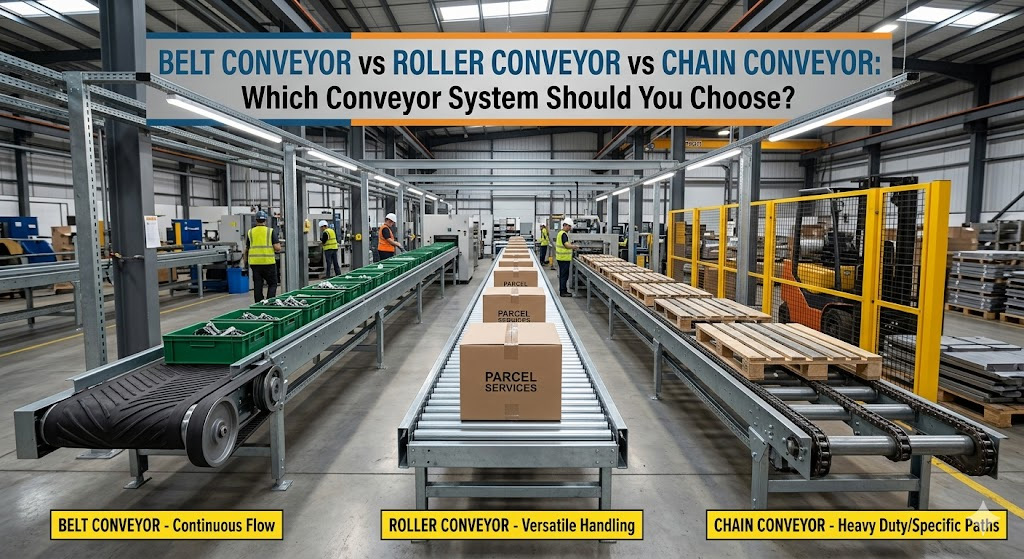
A belt conveyor is suitable for cartons, bags, packets, pouches and lightweight to medium-weight products.
A roller conveyor is suitable for cartons, boxes and flat-bottom loads.
A chain conveyor is suitable for heavier industrial goods, pallets and stronger movement requirements.
For local Mumbai buyers, Pan India factories and export customers, the right conveyor selection can reduce manual handling, improve packaging speed, support dispatch flow and make warehouse movement more efficient.
Sharp Engineering offers conveyor systems, packaging machines and material handling equipment for factories, warehouses, packaging units, logistics hubs and industrial dispatch applications. The right conveyor can be used independently or integrated with carton sealers, strapping machines, shrink packing machines, stretch wrapping machines, pallet trucks, stackers and other material handling equipment.
Why Conveyor Selection Matters
A conveyor system should not be selected only by price or appearance. It must match the product, load weight, product base, movement distance, working environment and required speed.
If the wrong conveyor is selected, the result may be poor movement, product slipping, carton jamming, belt wear, roller damage, machine downtime or slow dispatch.
For example, a flexible bag may not move properly on a roller conveyor because it does not have a stable flat base. A heavy industrial load may not be suitable for a light-duty belt conveyor. A small packet may require continuous belt support instead of roller gaps.
This is why buyers should first understand the difference between belt conveyors, roller conveyors and chain conveyors before making a decision.
What Is a Belt Conveyor?
A belt conveyor uses a continuous moving belt to carry products from one point to another.
The belt gives full surface support to the product. This makes it suitable for products that may not move smoothly on rollers or chains.
Belt conveyors are commonly used in packaging lines, food processing units, FMCG plants, pharmaceutical dispatch areas, e-commerce warehouses, assembly lines, inspection stations and product transfer applications.
They are especially useful for:
- Bags
- Pouches
- Packets
- Small cartons
- Light boxes
- Loose items
- Food packs
- Pharma packs
- Retail products
- Plastic components
- Light industrial goods
Because the belt surface is continuous, products remain more stable during movement.
When Should You Choose a Belt Conveyor?
You should choose a belt conveyor when your product needs continuous surface support.
This is important when products are small, soft, flexible, lightweight or unstable on rollers.
A belt conveyor is also useful when products need controlled movement between machines such as bag sealing machines, shrink packing machines, carton sealing lines, inspection stations or coding areas.
Choose a belt conveyor if:
Your product is a bag, pouch or packet.
Your product does not have a flat base.
Your cartons are light or small.
You need smooth product transfer.
You need movement between packaging stages.
You need a conveyor for inspection or sorting.
You need a conveyor for food, pharma or FMCG product movement.
For many packaging lines, a belt conveyor is the most flexible starting point.
Best Applications of Belt Conveyors
Belt conveyors are suitable for:
Packaging lines
Food processing
FMCG dispatch
Pharmaceutical packaging
E-commerce parcel movement
Bag movement
Pouch movement
Shrink packing lines
Inspection lines
Sorting areas
Assembly lines
Light product transfer
Coding lines
Retail product movement
In factories where products are light, packed in bags or need stable support, belt conveyors are a practical choice.
Advantages of Belt Conveyors
Belt conveyors provide continuous support to products.
They are suitable for small and irregular products.
They reduce manual movement between packaging stages.
They can be used in inclined movement applications.
They are suitable for many industries.
They can be integrated with packaging machines.
They support smoother movement for bags, pouches and packets.
They are useful for controlled transfer in packing and inspection areas.
Limitations of Belt Conveyors
Belt conveyors are not always suitable for very heavy industrial loads.
The belt surface can wear over time depending on product type and usage.
Sharp or rough products may require special belt selection.
For very heavy cartons, pallets or industrial loads, roller conveyors or chain conveyors may be better.
This is why load weight and product type must be checked before selecting a belt conveyor.
What Is a Roller Conveyor?
A roller conveyor uses a series of rollers to move goods from one point to another.
The product moves over rollers either by manual push, gravity or powered movement, depending on conveyor design.
Roller conveyors are commonly used for cartons, boxes, crates and flat-bottom products.
They are widely used in packaging lines, warehouses, logistics hubs, dispatch centres, e-commerce operations and carton handling applications.
Roller conveyors are especially useful for:
Carton boxes
E-commerce parcels
FMCG cartons
Pharma cartons
Appliance boxes
Industrial cartons
Warehouse dispatch boxes
Logistics sorting cartons
Flat-bottom crates
Packed goods with stable base
A roller conveyor is a strong choice when the product has a stable flat bottom and needs easy movement between packaging or dispatch stages.
When Should You Choose a Roller Conveyor?
You should choose a roller conveyor when your products are mostly cartons or boxes with a stable base.
Roller conveyors are useful before and after carton sealer machines, strapping machines, inspection tables and dispatch lines.
Choose a roller conveyor if:
You move cartons regularly.
Your boxes have flat bottoms.
You need carton movement after sealing.
You need carton movement before strapping.
You need warehouse dispatch movement.
You need an economical carton movement solution.
You want to reduce manual carrying of boxes.
You need accumulation between packaging stages.
For carton-based packaging lines, roller conveyors are often one of the most practical conveyor choices.
Best Applications of Roller Conveyors
Roller conveyors are suitable for:
Carton sealing lines
Strapping lines
Warehouse dispatch
E-commerce sorting
Logistics movement
FMCG carton movement
Pharmaceutical carton movement
Industrial box movement
Packing lines
Inspection areas
Loading support
Accumulation areas
They are commonly used in factories and warehouses where cartons move repeatedly between stages.
Advantages of Roller Conveyors
Roller conveyors are excellent for cartons and boxes.
They reduce manual lifting and pushing effort.
They are useful for accumulation before and after machines.
They are practical for warehouse movement.
They can be used with carton sealers and strapping machines.
They are suitable for dispatch and sorting areas.
They can be designed as gravity or powered systems.
They help create smooth carton movement in packaging lines.
Limitations of Roller Conveyors
Roller conveyors are not suitable for every product.
Flexible bags, small pouches, loose items and unstable products may not move smoothly on rollers.
If the product base is uneven, it may get stuck or tilt.
Roller spacing must match carton size.
For small products, belt conveyors may be better.
For heavy industrial loads, chain conveyors or heavy-duty roller conveyors may be required.
What Is a Chain Conveyor?
A chain conveyor uses chains to move heavier loads or products that require stronger support.
It is used where belt or roller conveyors may not be suitable because of weight, load structure or industrial handling conditions.
Chain conveyors are common in heavy manufacturing, engineering, automotive, pallet movement, industrial packaging, metal handling and demanding material movement applications.
They are especially useful for:
Heavy industrial goods
Pallet loads
Engineering components
Machinery parts
Metal components
Automotive parts
Heavy cartons
Industrial containers
Bulk movement
Strong base products
A chain conveyor is selected when the application requires higher strength and durability.
When Should You Choose a Chain Conveyor?
You should choose a chain conveyor when your product or load is heavy, industrial or unsuitable for belt or roller movement.
Chain conveyors are useful where load support, strength and controlled movement are important.
Choose a chain conveyor if:
Your load is heavy.
You move pallets or industrial goods.
You handle machinery parts.
You need stronger movement support.
Your product is not suitable for a light-duty conveyor.
You require rugged industrial handling.
Your application involves engineering or heavy manufacturing.
A chain conveyor is not usually selected for small packets or lightweight cartons. It is selected when strength is the priority.
Best Applications of Chain Conveyors
Chain conveyors are suitable for:
Heavy industrial movement
Engineering goods handling
Pallet transfer
Automotive component movement
Metal part movement
Heavy carton movement
Manufacturing plants
Industrial packaging lines
Warehouse load transfer
Assembly lines for heavier products
Export packing units handling heavy loads
For heavy-duty factory movement, chain conveyors can provide better strength and reliability.
Advantages of Chain Conveyors
Chain conveyors are suitable for heavy loads.
They are strong and durable.
They support industrial movement applications.
They are useful for pallet and heavy product transfer.
They are suitable for engineering and manufacturing industries.
They can handle demanding movement conditions.
They reduce manual handling of heavy goods.
They support safer movement for heavy industrial loads.
Limitations of Chain Conveyors
Chain conveyors may not be necessary for light products.
They are usually more application-specific than belt or roller conveyors.
They require proper design based on load weight, product base and movement distance.
For light cartons, a roller conveyor may be more practical.
For bags and pouches, a belt conveyor may be more suitable.
This is why chain conveyors should be selected only when the application requires stronger movement support.
Belt Conveyor vs Roller Conveyor vs Chain Conveyor: Main Difference
A belt conveyor gives continuous surface support and is suitable for bags, packets, pouches, cartons and light to medium products.
A roller conveyor moves cartons, boxes and flat-bottom goods using rollers.
A chain conveyor moves heavier industrial goods, pallets and strong-base loads using chains.
The simplest way to decide is:
Choose belt conveyor for bags, packets and light products.
Choose roller conveyor for cartons and boxes.
Choose chain conveyor for heavy industrial goods and pallets.
Comparison Table
| Parameter | Belt Conveyor | Roller Conveyor | Chain Conveyor |
|---|---|---|---|
| Best For | Bags, pouches, packets, light cartons | Cartons, boxes, flat-bottom goods | Heavy loads, pallets, industrial goods |
| Product Base | Flexible or flat | Flat and stable | Strong and load-bearing |
| Load Type | Light to medium | Light to medium-heavy cartons | Heavy-duty |
| Common Use | Packaging, food, pharma, FMCG | Warehousing, carton movement, dispatch | Engineering, industrial, pallet movement |
| Machine Integration | Bag sealing, shrink packing, inspection | Carton sealer, strapping machine, sorting | Heavy industrial lines, pallet transfer |
| Movement Support | Continuous belt surface | Roller-based movement | Chain-based movement |
| Best Buyer | Food, FMCG, pharma, e-commerce | Warehouses, logistics, carton dispatch | Engineering, manufacturing, heavy goods |
Which Conveyor Is Best for Packaging Lines?
For packaging lines, the best conveyor depends on the product.
If the line handles pouches, packets, bags, food packs or lightweight products, a belt conveyor is usually suitable.
If the line handles cartons and boxes, a roller conveyor is usually practical.
If the line handles heavy industrial products or pallets, a chain conveyor may be required.
In many factories, more than one conveyor type may be used in the same facility.
For example, a food product may move on a belt conveyor before packing. After carton sealing, the cartons may move on a roller conveyor. Once palletised, heavier loads may move using a pallet truck, stacker or chain conveyor system.
Which Conveyor Is Best for Carton Sealer Lines?
For carton sealer lines, roller conveyors are commonly used because sealed cartons usually have flat bases.
A roller conveyor before the carton sealer helps feed cartons to the machine.
A roller conveyor after the carton sealer helps collect or transfer sealed cartons toward strapping or dispatch.
If the cartons are small, lightweight or unstable, a belt conveyor may be considered.
The conveyor height and width should match the carton sealer machine and carton size.
Which Conveyor Is Best for Strapping Machines?
For strapping lines, roller conveyors are often suitable because cartons move smoothly into and out of the strapping zone.
A conveyor can improve the flow before and after semi-auto or fully auto strapping machines.
For heavier goods, a heavy-duty roller conveyor or chain conveyor may be required.
For small packets or non-carton products, belt conveyors may be better.
Which Conveyor Is Best for Shrink Packing Lines?
Shrink packing lines often require belt conveyors because products may be small, light or retail-focused.
A belt conveyor supports product movement from loading to sealing, shrinking and collection.
For boxed products after shrink packing, roller conveyors may also be used in later stages.
The conveyor selection depends on product size, pack stability and line flow.
Which Conveyor Is Best for Warehouse Dispatch?
Warehouse dispatch usually handles cartons, boxes and parcels.
Roller conveyors are common for carton movement and sorting.
Belt conveyors are useful for parcels, packets, bags and mixed products.
Truck loader conveyors are useful when goods need to move into trucks or containers.
For heavier loads or pallets, chain conveyors or material handling equipment may be required.
Which Conveyor Is Best for Heavy Industrial Goods?
For heavy industrial goods, chain conveyors or heavy-duty roller conveyors are usually better.
Engineering goods, metal components, machinery parts and heavy cartons require stronger support.
The conveyor must be designed based on load weight, product base, movement distance and safety requirements.
For very heavy movement, conveyors may also need to work with EOT cranes, stackers, goods lifts or pallet trucks.
Industry-Wise Conveyor Selection
E-Commerce and Logistics
E-commerce and logistics operations usually need roller conveyors and belt conveyors.
Roller conveyors are suitable for cartons and parcels.
Belt conveyors are useful for small packets and mixed product movement.
Truck loader conveyors can support dispatch loading.
Useful supporting machines include carton sealers, strapping machines, stretch wrapping machines and pallet trucks.
FMCG and Food Processing
FMCG and food units often use belt conveyors because products may be packets, pouches, bottles, bags or small packs.
Roller conveyors may be used after carton packing.
Useful supporting machines include shrink packing machines, L sealers, bag sealing machines, carton sealers and stretch wrapping machines.
Pharmaceuticals
Pharmaceutical packaging and dispatch may use belt conveyors, roller conveyors and coding conveyors.
Belt conveyors are useful for product movement and inspection.
Roller conveyors are useful for carton movement.
Useful supporting machines include carton sealers, shrink packing machines and stretch wrapping machines.
Engineering Goods
Engineering goods may require chain conveyors, heavy-duty roller conveyors and material handling equipment.
Useful supporting machines include strapping machines, stretch wrapping machines, stackers, EOT cranes and goods lifts.
Warehouses and Distribution Centres
Warehouses commonly use roller conveyors for cartons and belt conveyors for mixed products.
Material handling equipment such as hand pallet trucks and stackers can support movement after conveyor sections.
Export Packaging Units
Export packaging units may use roller conveyors for carton movement, belt conveyors for product transfer and chain conveyors for heavy loads.
Useful supporting machines include carton sealers, strapping machines, stretch wrapping machines and pallet handling equipment.
Local Mumbai Conveyor Requirements
Mumbai, Thane, Navi Mumbai, Bhiwandi, Vasai, Taloja, Pune, Nashik and other Maharashtra industrial areas have strong demand for conveyor systems because of packaging, logistics, pharma, FMCG, engineering and warehouse operations.
Local buyers often need conveyors for:
Packaging lines
Carton sealing lines
Warehouse dispatch
E-commerce sorting
Food processing
Industrial movement
Truck loading
Material handling
A Mumbai-based supplier like Sharp Engineering can help buyers discuss product type, carton size, load weight, factory layout and conveyor integration more clearly.
Pan India Conveyor Requirements
Across India, conveyor systems are required by factories and warehouses in Delhi NCR, Gujarat, South India, East India and Central India.
Delhi NCR buyers often need conveyors for e-commerce, logistics, manufacturing and auto components.
Gujarat buyers often need conveyors for pharma, chemicals, food, textiles, plastics and export units.
South India buyers need conveyors for automotive, electronics, engineering, FMCG, pharma and food processing.
East India buyers need conveyors for warehouses, manufacturing, distribution and industrial movement.
For Pan India buyers, conveyor selection should be based on application details, not only standard models.
Export Buyer Conveyor Requirements
Export buyers often look for conveyor systems from India for factories, warehouses and packaging lines.
Belt conveyors, roller conveyors and chain conveyors can serve different international industries.
Importers may also combine conveyors with carton sealers, strapping machines, stretch wrapping machines and material handling equipment to offer complete packaging and dispatch solutions.
This makes conveyor systems a strong category for global industrial buyers.
How to Choose the Right Conveyor
Before selecting a conveyor, buyers should share complete application details.
Product Type
Is the product a carton, bag, pouch, box, packet, bottle, component or pallet?
This decides whether belt, roller or chain conveyor is suitable.
Product Weight
Weight directly affects conveyor design.
Light products may move on belt conveyors.
Cartons may move on roller conveyors.
Heavy products may need chain conveyors.
Product Base
A flat carton can move on rollers.
A bag or pouch needs belt support.
A heavy pallet may need chain movement or material handling support.
Product Size
Conveyor width, length, roller pitch, belt type and side guides depend on product size.
Movement Distance
A short transfer line needs a simple conveyor.
A long movement line may need multiple conveyor sections, bends, supports or loading systems.
Required Speed
The conveyor speed should match production speed and packaging machine speed.
Factory Layout
The conveyor must fit available space, machine placement, operator movement and dispatch flow.
Integration Requirement
If the conveyor connects with a carton sealer, strapping machine, shrink packing machine or loading system, machine height and flow direction must be planned properly.
Common Mistakes Buyers Should Avoid
One common mistake is selecting a conveyor without checking product base.
For example, using a roller conveyor for flexible bags can create movement problems.
Another mistake is selecting a light-duty conveyor for heavy goods.
Some buyers also ignore machine integration. If conveyor height does not match the connected machine, the line may not work smoothly.
Another mistake is buying only for current volume without thinking about future expansion.
The best conveyor is selected after understanding product, load, layout and process flow.
Why Choose Sharp Engineering
Sharp Engineering offers conveyor systems, packaging machines and material handling equipment for local Mumbai, Pan India and export buyers.
The company’s conveyor range includes belt conveyors, roller conveyors and chain conveyors, which can support different packaging, warehouse and industrial movement needs.
Because Sharp Engineering also offers packaging machines and material handling equipment, buyers can plan a complete workflow instead of selecting conveyors separately.
For example, a buyer may need a roller conveyor with a carton sealer, a belt conveyor with a shrink packing machine, or a chain conveyor with heavy material handling equipment.
This complete product ecosystem helps buyers improve packaging and dispatch efficiency.
Final Advice for Buyers
Do not select a conveyor only by name.
Select it by product type.
If you handle bags, packets or pouches, choose a belt conveyor.
If you handle cartons and boxes, choose a roller conveyor.
If you handle heavy industrial goods or pallets, choose a chain conveyor.
For complex factories, you may need more than one conveyor type.
Sharp Engineering can help buyers choose the right conveyor system based on product type, load weight, movement distance, factory layout and packaging line requirement.
Call to Action
Not sure whether your factory needs a belt conveyor, roller conveyor or chain conveyor?
Share your product type, carton size, load weight, product base, movement distance, required speed and factory layout with Sharp Engineering. The team can suggest the right conveyor system for your packaging line, warehouse, factory or dispatch operation.
FAQs
What is the difference between belt conveyor, roller conveyor and chain conveyor?
A belt conveyor uses a continuous belt for bags, pouches and light products. A roller conveyor uses rollers for cartons and boxes. A chain conveyor uses chains for heavier industrial goods and pallets.
Which conveyor is best for cartons?
A roller conveyor is commonly suitable for cartons and boxes with flat and stable bases.
Which conveyor is best for bags and pouches?
A belt conveyor is usually best for bags, pouches and packets because it provides continuous surface support.
Which conveyor is best for heavy goods?
A chain conveyor or heavy-duty roller conveyor is suitable for heavy industrial goods.
Can belt conveyors be used in packaging lines?
Yes. Belt conveyors are widely used in packaging lines for product transfer, inspection, sorting and movement between machines.
Can roller conveyors be used with carton sealer machines?
Yes. Roller conveyors are commonly used before and after carton sealer machines for smooth carton movement.
Can roller conveyors be used with strapping machines?
Yes. Roller conveyors can move cartons into and out of strapping machines, helping improve line flow.
When should I choose a chain conveyor?
Choose a chain conveyor when the load is heavy, industrial or unsuitable for light-duty belt or roller conveyors.
Are belt conveyors suitable for food and FMCG products?
Yes. Belt conveyors are commonly used in food, FMCG, pharma and packaging applications.
Are roller conveyors suitable for warehouses?
Yes. Roller conveyors are widely used in warehouses, logistics centres, e-commerce hubs and dispatch lines for carton movement.
Which conveyor is suitable for export packaging?
Export packaging may use roller conveyors for cartons, belt conveyors for product movement and chain conveyors for heavy loads.
How do conveyors reduce labour cost?
Conveyors reduce manual lifting, carrying and shifting, allowing workers to focus on packing, inspection and dispatch coordination.
Can one factory use multiple conveyor types?
Yes. Many factories use belt conveyors for products, roller conveyors for cartons and chain conveyors for heavy loads.
What details are needed before selecting a conveyor?
You should share product type, product size, load weight, product base, movement distance, speed requirement and factory layout.
Why choose Sharp Engineering for conveyor systems?
Sharp Engineering offers belt conveyors, roller conveyors, chain conveyors, packaging machines and material handling equipment for factories, warehouses and dispatch units.