In many factories and warehouses, the biggest challenge is not only packing the product. The real challenge is moving the product safely, quickly and without damaging goods or overloading workers.
A warehouse may need to lift pallets to storage height.
A manufacturing unit may need to move heavy machinery parts.
A multi-floor factory may need to shift goods from ground floor to upper floors.
A packaging unit may need to move finished cartons to dispatch.
An engineering plant may need to handle heavy industrial loads.
A logistics warehouse may need faster pallet movement and stacking.
This is where the right material handling equipment becomes important.
But many buyers get confused between Goods Lift, EOT Crane and Stacker. All three are used for material movement, but they are not the same. Each machine solves a different handling problem.
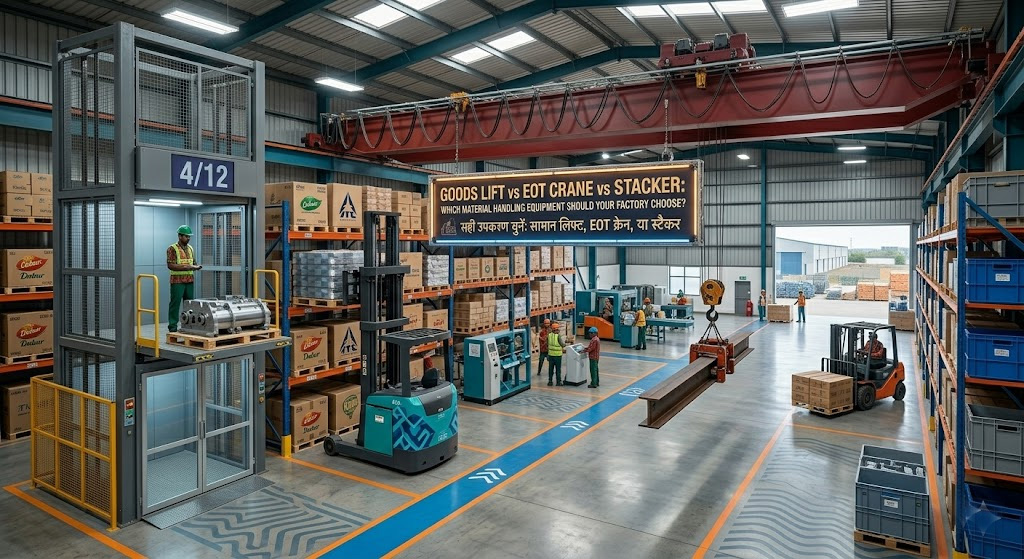
A Goods Lift is used for vertical movement between floors.
An EOT Crane is used for heavy load lifting and movement inside industrial spaces.
A Stacker is used for lifting, stacking and moving pallets or loads at warehouse level.
Sharp Engineering offers material handling equipment, packaging machines and conveyor systems for factories, warehouses, logistics units, packaging departments and industrial dispatch applications. For buyers in Mumbai, Maharashtra, Pan India and export markets, choosing the right machine depends on load type, lifting height, movement direction, floor layout, warehouse space and daily usage.
Why Choosing the Right Material Handling Equipment Matters
Wrong material handling equipment can create serious operational problems.
If a factory uses manual labour for heavy loads, worker safety becomes a risk.
If a warehouse uses the wrong lifting equipment, movement becomes slow.
If goods are shifted between floors without a proper goods lift, the process becomes unsafe and inefficient.
If heavy components are moved without an EOT crane, damage risk increases.
If pallets are stacked manually, storage space is not used properly.
Material handling equipment directly affects:
Worker safety
Movement speed
Warehouse organisation
Dispatch efficiency
Load protection
Labour productivity
Factory workflow
Storage space utilisation
This is why a buyer should not choose equipment only by price. The selection should be based on actual application.
What Is a Goods Lift?
A goods lift is used to move material vertically between floors.
It is commonly used in factories, warehouses, storage buildings, packaging units, industrial facilities, retail stockrooms and multi-floor manufacturing setups.
A goods lift is useful when goods need to move from ground floor to first floor, mezzanine floor, storage floor or dispatch floor.
It reduces manual lifting and helps move heavy or bulky material safely between levels.
When Should You Choose a Goods Lift?
You should choose a goods lift when your main problem is vertical movement between floors.
For example:
Your warehouse has storage on upper floors.
Your factory production area and packing area are on different floors.
Finished goods need to move from production to dispatch level.
Raw materials need to be lifted to a processing floor.
Packed cartons need to be transferred between levels.
Workers are manually carrying boxes or material through staircases.
In such cases, a goods lift is the correct solution.
A stacker may lift material to a certain height, but it is not designed to move goods between building floors. An EOT crane can lift heavy loads, but it is not the practical choice for routine floor-to-floor material transfer in most warehouses.
Best Applications of Goods Lifts
Goods lifts are suitable for:
Multi-floor warehouses
Manufacturing units
Packaging units
Pharma storage areas
FMCG warehouses
Industrial buildings
Retail stockrooms
Logistics facilities
Food processing units
Engineering workshops
Dispatch buildings
Goods lifts are especially useful in cities like Mumbai, Thane, Navi Mumbai, Bhiwandi, Vasai, Pune, Delhi NCR, Bengaluru, Chennai, Hyderabad and Ahmedabad, where industrial spaces often use vertical storage to save floor area.
What Is an EOT Crane?
An EOT crane, or Electric Overhead Travelling Crane, is used for lifting and moving heavy loads across an industrial area.
It usually moves along overhead rails and is used in factories where heavy products, raw material, machinery parts, metal components or industrial loads need to be lifted and shifted.
An EOT crane is mainly used for heavy-duty applications where normal manual handling, pallet trucks or stackers are not enough.
When Should You Choose an EOT Crane?
You should choose an EOT crane when your factory handles heavy loads that need safe lifting and horizontal movement inside the facility.
For example:
You need to lift heavy engineering components.
You need to move metal parts across the workshop.
You need to handle machinery, dies, motors or fabrication items.
Your products are too heavy for pallet trucks or stackers.
You need overhead lifting because floor movement is difficult.
You need controlled movement for heavy industrial loads.
An EOT crane is not usually selected for routine carton movement or small warehouse loads. It is selected for industrial load handling where strength and safety are critical.
Best Applications of EOT Cranes
EOT cranes are suitable for:
Engineering units
Fabrication workshops
Heavy manufacturing plants
Machinery manufacturers
Metal processing units
Automotive component units
Industrial warehouses
Tool rooms
Heavy equipment handling
Steel and fabrication industries
If the load is heavy, irregular, difficult to move manually or unsafe to handle at floor level, an EOT crane may be the right solution.
What Is a Stacker?
A stacker is used to lift, stack and move pallets or loads within a warehouse or factory.
It is commonly used when goods need to be lifted to storage racks, stacked in warehouses or moved over short distances.
A stacker is especially useful where a hand pallet truck can move goods but cannot lift them to the required height.
When Should You Choose a Stacker?
You should choose a stacker when your main requirement is pallet lifting and stacking.
For example:
You need to lift pallets to storage racks.
You need to stack goods vertically.
You need to load or unload pallets at a certain height.
You need to move palletised goods inside the warehouse.
You want to reduce manual lifting.
You want to improve storage space utilisation.
A stacker is ideal for warehouse-level lifting and stacking. It is not meant for moving goods between building floors like a goods lift. It is also not meant for very heavy industrial loads that require an EOT crane.
Best Applications of Stackers
Stackers are suitable for:
Warehouses
FMCG storage areas
Pharma warehouses
E-commerce fulfilment centres
Packaging units
Factories
Retail distribution centres
Food processing units
Logistics hubs
Export packing units
Stackers help businesses use vertical space better and reduce manual lifting in daily warehouse operations.
Goods Lift vs EOT Crane vs Stacker: Main Difference
A goods lift moves goods vertically between floors.
An EOT crane lifts and moves heavy industrial loads across a defined factory area.
A stacker lifts and stacks pallets or goods within a warehouse or storage area.
These machines are not direct replacements for one another. The right choice depends on the movement requirement.
If your material needs to move from one floor to another, choose a goods lift.
If your material is very heavy and needs overhead movement, choose an EOT crane.
If your pallets need to be lifted and stacked in storage, choose a stacker.
Simple Selection Guide for Buyers
Choose a Goods Lift If
Your factory or warehouse has multiple floors.
Goods need to move vertically.
Workers are carrying material by staircase.
Material movement between floors is slow.
Your facility uses mezzanine or upper-floor storage.
You want safer floor-to-floor movement.
A goods lift is best when movement is vertical and repeated.
Choose an EOT Crane If
Your load is very heavy.
You handle machinery parts, metal parts or industrial components.
You need overhead lifting.
Floor-based movement is difficult or unsafe.
You need controlled lifting across a factory bay.
Manual lifting is impossible or risky.
An EOT crane is best for heavy-duty industrial handling.
Choose a Stacker If
You need to lift pallets.
You need to stack goods vertically.
You want to place goods on racks.
You need short-distance pallet movement.
You want to reduce manual lifting in a warehouse.
You need equipment for regular warehouse handling.
A stacker is best for pallet lifting and storage support.
Industry-Wise Equipment Selection
E-Commerce Warehouses
E-commerce warehouses usually need fast carton movement, pallet movement and storage support.
Recommended equipment:
Stacker
Hand pallet truck
Roller conveyor
Belt conveyor
Goods lift, if multi-floor
Carton sealer
Strapping machine
A stacker is useful for pallet handling and storage. A goods lift is needed only if goods move between floors. An EOT crane is usually not required unless the warehouse handles very heavy industrial goods.
FMCG Warehouses
FMCG companies handle cartons, boxes, bags, bottles and pallets.
Recommended equipment:
Stacker
Hand pallet truck
Goods lift for multi-floor storage
Belt conveyor
Roller conveyor
Stretch wrapping machine
Carton sealer
A stacker helps with pallet storage. A goods lift supports vertical movement. Stretch wrapping helps secure pallet loads before dispatch.
Pharmaceutical Warehouses
Pharmaceutical warehouses need organised, clean and careful movement.
Recommended equipment:
Stacker
Goods lift
Hand pallet truck
Roller conveyor
Belt conveyor
Carton sealer
Stretch wrapping machine
A goods lift is useful in multi-floor pharma storage. Stackers support pallet handling. Conveyors support movement between packing and dispatch areas.
Engineering Goods Manufacturing
Engineering goods may be heavier and more difficult to handle.
Recommended equipment:
EOT crane
Stacker
Goods lift
Chain conveyor
Roller conveyor
Heavy-duty trolley
Strapping machine
Stretch wrapping machine
EOT cranes are highly useful for heavy components. Stackers are useful for palletised goods. Goods lifts are useful if material moves between floors.
Food Processing Units
Food processing units may handle bags, cartons, bottles and pallets.
Recommended equipment:
Stacker
Goods lift
Hand pallet truck
Belt conveyor
Bag sealing machine
Carton sealer
Shrink packing machine
Stretch wrapping machine
Stackers and goods lifts improve storage and movement. Conveyors support packing flow.
Export Packing Units
Export units need strong packaging and safe material movement.
Recommended equipment:
Stacker
Hand pallet truck
Goods lift, if required
EOT crane for heavy goods
Roller conveyor
Stretch wrapping machine
Strapping machine
Carton sealer
The right equipment depends on whether the export goods are cartons, pallets, machinery parts or heavy industrial products.
Local Mumbai and Maharashtra Requirement
In Mumbai and Maharashtra, industrial space is often limited, and many factories operate with compact layouts or multi-floor facilities.
Areas such as Andheri, Thane, Navi Mumbai, Bhiwandi, Vasai, Taloja, Pune, Nashik and Aurangabad have strong demand for goods lifts, stackers, pallet trucks, conveyors and EOT cranes.
A goods lift is useful where storage or production is spread across floors.
A stacker is useful in warehouses and dispatch areas.
An EOT crane is useful in engineering and heavy industrial facilities.
Sharp Engineering’s Mumbai base is useful for local buyers who want to discuss application requirements, load weight, lifting height, floor layout and equipment selection.
Pan India Requirement for Goods Lifts, EOT Cranes and Stackers
Across India, demand for material handling equipment is growing because factories and warehouses want to reduce labour dependency and improve movement safety.
Delhi NCR buyers often need stackers, conveyors and goods lifts for logistics, e-commerce and manufacturing.
Gujarat buyers often need goods lifts, EOT cranes, stackers and conveyors for pharma, chemicals, engineering, plastics and export units.
South India buyers in Chennai, Bengaluru, Coimbatore, Hyderabad and Hosur often need stackers, conveyors, EOT cranes and material handling equipment for automotive, electronics, engineering and manufacturing.
East India buyers may need goods lifts, stackers, trolleys and conveyors for warehouses, distribution centres and manufacturing units.
For Pan India buyers, the right supplier should understand application, not just sell equipment by name.
Load Weight: The Most Important Selection Factor
Load weight is one of the first things to check before choosing between a goods lift, EOT crane and stacker.
For moderate pallet loads, a stacker may be suitable.
For floor-to-floor movement of goods, a goods lift may be suitable depending on capacity.
For very heavy industrial loads, an EOT crane may be required.
Never select equipment without knowing maximum load weight.
Overloading the wrong equipment can create safety risks, machine damage and operational downtime.
Lifting Height and Movement Direction
The second important factor is movement direction.
If the material needs to move upward to storage racks, a stacker may be suitable.
If the material needs to move between building floors, a goods lift is suitable.
If the material needs to move overhead across a bay or workshop, an EOT crane is suitable.
Lifting height and direction decide the equipment type.
Floor Space and Layout
The factory or warehouse layout also affects equipment selection.
A stacker needs aisle space and turning space.
A goods lift needs a proper installation location and floor access.
An EOT crane needs structural planning, overhead clearance and movement area.
Before buying, share layout details with the supplier.
This helps avoid mistakes in equipment selection and installation planning.
Frequency of Use
How often will the equipment be used?
If goods move between floors many times per day, a goods lift becomes important.
If pallets are stacked throughout the day, a stacker is required.
If heavy loads are lifted regularly, an EOT crane is necessary.
Equipment should match daily usage intensity.
A low-usage application and high-usage application may require different specifications.
Safety Considerations
Material handling equipment must be selected with safety in mind.
Workers should not manually lift heavy or risky loads when machines can do the job safely.
A goods lift reduces stairway carrying.
A stacker reduces manual pallet lifting.
An EOT crane reduces unsafe heavy-load handling.
Conveyors reduce repeated manual carrying.
Good material handling equipment helps improve workplace safety and reduce injury risk.
Can These Machines Work Together?
Yes. In many factories, goods lifts, EOT cranes and stackers may all be used together, but for different purposes.
For example:
An EOT crane may lift heavy raw material in the production area.
A conveyor may move semi-finished products to the packaging area.
A carton sealer and strapping machine may prepare goods for dispatch.
A stacker may lift palletised cartons into storage.
A goods lift may move packed goods to another floor.
A stretch wrapping machine may secure pallets before transport.
This complete system creates a smoother factory and warehouse flow.
Common Mistakes Buyers Should Avoid
One common mistake is buying a stacker when the real requirement is floor-to-floor movement. In that case, a goods lift may be needed.
Another mistake is buying a goods lift when the real issue is heavy industrial lifting inside a workshop. In that case, an EOT crane may be better.
Some buyers select equipment only by capacity but ignore space, layout and frequency of use.
Others choose the lowest-price option without checking safety, suitability and long-term performance.
The correct approach is to study the movement requirement first.
Questions to Ask Before Buying
Before selecting a goods lift, EOT crane or stacker, ask:
What is the maximum load weight?
What type of material will be handled?
Is the load palletised?
Does the material need vertical movement between floors?
Does the material need lifting to racks?
Does the material need overhead movement?
How many times per day will the equipment be used?
What is the available floor space?
What is the lifting height?
What is the warehouse or factory layout?
Is the equipment for light, medium or heavy-duty use?
These questions help select the right equipment.
Why Choose Sharp Engineering
Sharp Engineering offers material handling equipment, packaging machines and conveyor systems for factories, warehouses and industrial units.
For buyers choosing between goods lifts, EOT cranes and stackers, the advantage is that Sharp Engineering’s range supports the broader movement and packaging process.
A buyer may need a stacker for pallet lifting, a goods lift for vertical movement, an EOT crane for heavy load handling, conveyors for line movement and packaging machines for carton sealing, strapping or wrapping.
This makes Sharp Engineering suitable for local Mumbai buyers, Pan India industrial buyers and export customers looking for practical material handling and packaging support.
Final Advice for Buyers
Do not choose a goods lift, EOT crane or stacker only because someone suggested it.
Choose based on movement type.
If goods need to move between floors, choose a goods lift.
If heavy loads need overhead movement, choose an EOT crane.
If pallets need lifting and stacking, choose a stacker.
If cartons need continuous line movement, add conveyors.
If packed goods need safe dispatch, combine material handling with packaging machines such as carton sealers, strapping machines and stretch wrapping machines.
Sharp Engineering can help buyers select the right material handling equipment based on load weight, lifting height, movement direction, factory layout and daily usage.
Call to Action
Not sure whether your factory needs a goods lift, EOT crane or stacker?
Share your load weight, material type, lifting height, movement direction, floor layout, daily usage and factory location with Sharp Engineering. The team can help you choose the right material handling equipment for safe movement, better storage and faster dispatch.
FAQs
What is the difference between a goods lift and a stacker?
A goods lift moves material vertically between floors, while a stacker lifts and stacks pallets or loads within a warehouse or factory area.
What is the difference between an EOT crane and a goods lift?
An EOT crane is used for heavy overhead lifting and movement inside industrial spaces, while a goods lift is used for moving goods between floors.
What is the difference between an EOT crane and a stacker?
An EOT crane handles heavy industrial loads through overhead movement, while a stacker is used for lifting and stacking palletised loads.
When should I choose a goods lift?
Choose a goods lift when material needs to move between floors in a factory, warehouse or industrial building.
When should I choose an EOT crane?
Choose an EOT crane when heavy industrial loads need to be lifted and moved safely across a workshop or factory bay.
When should I choose a stacker?
Choose a stacker when you need to lift pallets, stack goods or place loads on warehouse racks.
Can a stacker replace a goods lift?
No. A stacker cannot replace a goods lift for floor-to-floor movement. It is mainly used for lifting and stacking within the same operating level.
Can a goods lift replace an EOT crane?
No. A goods lift is for vertical floor-to-floor movement, while an EOT crane is for heavy overhead lifting and horizontal movement.
Which equipment is best for warehouse pallet handling?
A stacker or hand pallet truck is commonly used for warehouse pallet handling, depending on lifting height and load requirement.
Which equipment is best for heavy industrial loads?
An EOT crane is suitable for heavy industrial loads that require safe lifting and movement.
Which equipment is best for multi-floor warehouses?
A goods lift is suitable for multi-floor warehouses where goods need to move between levels.
Do I need conveyors with stackers or goods lifts?
Conveyors may be useful if goods need continuous movement between packing, storage and dispatch areas.
Which industries use goods lifts?
Goods lifts are used in warehouses, factories, food units, pharma storage, packaging units, retail stockrooms and multi-floor industrial buildings.
Which industries use EOT cranes?
EOT cranes are used in engineering, fabrication, machinery manufacturing, metal processing, automotive components and heavy industrial facilities.
Why choose Sharp Engineering for material handling equipment?
Sharp Engineering offers goods lifts, EOT cranes, stackers, conveyors and packaging machines, making it suitable for factories and warehouses that need complete material movement and dispatch support.